Top Line vs Bottom Line Growth: What's the Difference?


Top line vs bottom line: What's important for your ecommerce brand?

As an online or Shopify ecommerce store owner, there are three lines that are the most important to you—online, your top line and your bottom line.
You’ve just received your ecommerce brand’s profit and loss (P&L) statement (also known as an income statement). There is only one thought on your mind. Have you made a profit or a loss? Has your marketing really been successful in growing your sales?
To really find this answer you’ll need to dig deeper into both your top line income and your bottom line income.
So, what’s the difference and which one is the most important metric for your ecommerce accounting and ecommerce bookkeeping as you look to grow your ecommerce business?
{{promo-strip}}
Top Line
The top line is the gross revenue (also known as gross sales or gross receipts) at the very top of your P&L.
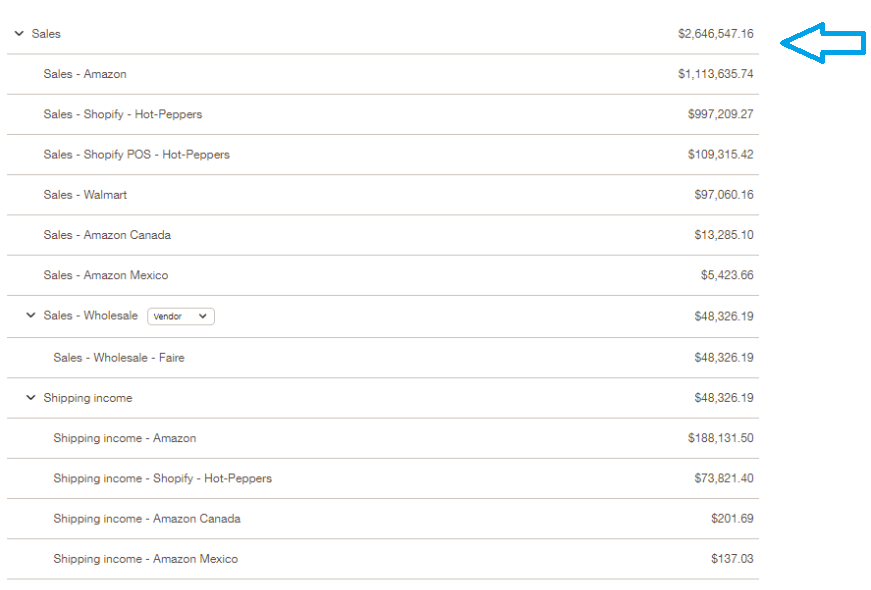
Simply put, it’s the gross sales that you collect from customers, including via wholesale, Shopify, Amazon, or your stand at the local farmer’s market. So, if you have achieved top line growth it means that you have made more sales than the previous period.
Top line income, or gross sales, is not the same as gross profit or gross income. Gross profit/income is the money that remains after subtracting your cost of goods sold (COGS), shipping expenses to customers, and your merchant fees.
Top line, on the other hand, is your gross sales and revenue before you deduct any COGS or any of your operating expenses such as salaries and ad spend. It also doesn’t reflect the impact of discounts or reductions from returns.
3 ways you can improve your top line growth
Increases in revenue often directly relate to increases in ad spend, or improving your product offering. Here are a few ways you can improve your top-line growth (tried and tested ways that we’ve seen work for our customers):
- Focus on customer retention - whether by offering a subscription model, discounts or freebies for returning customers, or focusing on CX to retain existing customers.
- Invest wisely in advertising to convert new leads. Not all advertising platforms are created equal. Research where your competitors are most active and on which platforms your target audience spends their time. Make every dollar work for you by actively tracking your ROAS.
- Offer new products to expand into new and untapped markets.
Bottom Line
Your bottom line income is, you guessed it, the net income or net profit at the very bottom of your P&L.
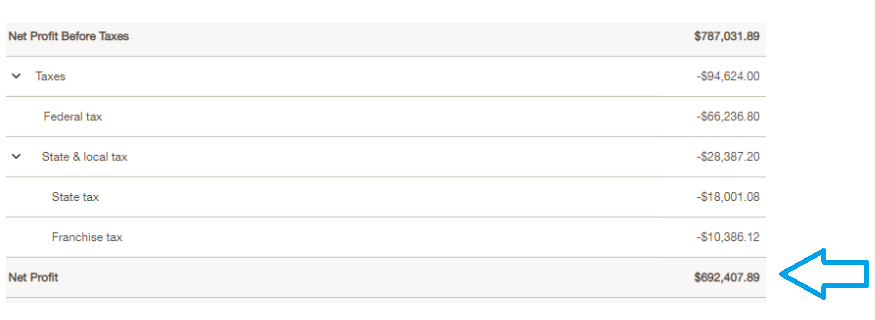
It shows your net revenue after subtracting your overheads, including COGS, G&A expenses, salaries, advertising & marketing, depreciation, interest, taxes, etc.
Your bottom line income reveals how well you manage your costs.
Growth means you decreased your operating expenses and overheads or that you increased your top line income. A decline from the previous period, means you’ve either suffered a dip in income or a surge in expenses.
From an accounting point of view, your bottom line doesn’t carry over to next year’s P&L, although the impact likely will affect your brand moving forward. Instead, at year end it’s transferred to your retained earnings and you get to start your P&L from scratch on Day 1 of your new accounting period (usually January 1).
3 ways you can improve your bottom line growth
- Follow your expenses in real-time
Tracking your expenses for your ecommerce brand is key. If you don’t know how much you’re spending, you can’t make better cost management decisions. Using an AI accounting and AI bookkeeping real-time bookkeeping service like Finaloop can help you track all your expenses and give you the visibility you need to grow your profit.
- Price your products using data, not just a hunch
Focus on unit economics to understand how much each product actually costs you to sell. Once you understand your cost per unit you can calculate gross margins and break-even points, determine the best price for your product, forecast your profits, and optimize your product offerings.
Check out our profit margin calculator to help you price your products to optimize growth.
- Make sure bottom line growth equals or exceeds top line growth
As you scale your brand, you will have a lot more opportunities for cost savings, such as negotiating bulk discounts with vendors. If you are increasing your sales but not seeing an equal or higher percentage increase in net profit, your sales can actually be hurting your business.
So, which should you focus on for your ecomm brand?
Many brands tend to over focus on the top line while neglecting whether the top line growth actually impacted their bottom line.
One Finaloop customer, a DTC brand, grossed about $12 million a year in revenue but realized they actually were operating at a net loss. After joining Finaloop and working with real-time numbers, they decided to decrease their ad spend and better manage their inventory costs. Now they make about $7 million a year in revenue, but are operating at a profit.
The big picture matters. Your bottom line is key to your brand's survival.
The success of your ecommerce business depends on you having a full understanding of your financials and your numbers. In this turbulent economy, really knowing your real-time bottom line will help you introduce cost-cutting measures and grow your profit. Finaloop can help you do exactly this by giving you the numbers and tools you need to make better decisions and increase your bottom line.
About Finaloop
We are a technology company providing automated end-to-end accounting service to ecommerce businesses. Our system connects to your apps, syncs all your data and reconciles your books in real-time, replacing your bookkeeper. We offer reconciled books available 24/7, tax-saving insights, and a single place for all your financial data.
*The information provided on this website does not, and is not intended to, constitute legal advice. All information, content, and materials available on this site are for general informational purposes only. Readers are advised to consult with their attorney or accountant with any questions or concerns.*

That’s what we’re here for.
Accurate ecommerce books, done for you.
100% accurate ecommerce books, available 24/7.
Finally, you can focus on everything else.